
Projects
Caribbean Efficient and Green Energy Buildings (CEGEB) Project
Project Information
Approval Date: February 2025
Starting Date: August 2025
Ending Date: 30 June 2031
Executing Entity: Ministry of Climate Resilience, the Environment and Renewable Energy
Funding Agency: World Bank
Total Funding Amount: USD$57.50M
Project Details
The Caribbean Efficient and Green-Energy Buildings Project (CEGEB) is a regional initiative designed to improve energy efficiency, expand the use of renewable energy in public buildings and facilities, and strengthen the policy and regulatory environment for sustainable energy investment across participating Caribbean countries.
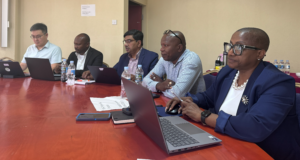
Pictured right: The Grenada CEGEB World Bank Mission was held 24-28 August 2026. The full-day working sessions, dialogue and site visits on Grenada and Carriacou engaged national stakeholders, project officers and the World Bank delegation.
Pictured foreground to background: MCRERE Permanent Secretary Peron Johnson, Director, MCRERE Renewable Energy Division & National Ozone Officer Leslie Smith, World Bank Task Team Leader & Senior Energy Specialist – Caribbean Energy, Ashok Sarkar, Ph.D., CEGEB Renewable Energy Officer Davrell Bhola, and World Bank Energy Specialist, Ph.D., Infra Latin America & Caribbean Energy Chong Suk Song.
In Grenada, the project combines energy-efficiency improvements to public buildings with renewable energy development, battery energy storage and electricity transmission upgrades to support a cleaner, more efficient and resilient energy system.
Project Objective
CEGEB aims to save energy, increase the use of renewable energy in public buildings and facilities, and enhance the regulatory framework for investments in energy efficiency and renewable energy in participating Caribbean countries.
The first participating countries are Grenada, Saint Lucia and Guyana, with regional support from the Organisation of Eastern Caribbean States (OECS) and the CARICOM Centre for Renewable Energy and Energy Efficiency (CCREEE).
Why CEGEB Matters
Grenada remains highly dependent on imported fossil fuels for electricity generation, contributing to high energy costs and exposure to fluctuations in global fuel prices. Public buildings also represent an important opportunity to reduce electricity consumption and operating costs through more efficient lighting, cooling and other building systems, while expanding the use of distributed renewable energy.
At the same time, increasing renewable energy generation requires investments in the national electricity grid so that variable renewable resources can be safely and reliably integrated.
CEGEB addresses these challenges through a coordinated programme of public-building energy upgrades, renewable energy investments, battery storage, transmission improvements, regulatory reform and institutional capacity building.
Above: Hillsborough Smart Health Centre in Carriacou. Aerial roof assessments are a modern approach to evaluating the condition of a property’s roof without an initial physical intervention. These assessments provide insights into the roof’s characteristics (type, size, slope, drainage systems, potential problem areas) all without the risks associated with a traditional inspection. Further, these assessments are particularly useful for planning repairs, or installations like solar PV panels. Photography: Grenada World Bank Mission.
Key Components
1. Investments in Energy Efficiency, Distributed Renewable Energy and Grid Resilience
This component finances energy-efficiency measures and distributed renewable energy systems for Grenada’s public sector, together with investments to strengthen the resilience and capacity of the national electricity grid.
For public buildings, activities include identifying and assessing suitable facilities, conducting energy investment-grade audits, designing energy-efficiency retrofits and renewable energy systems, and supporting their construction and operation.
The component also supports major electricity infrastructure investments implemented through the Grenada Electricity Services Limited (GRENLEC), including battery energy storage and associated transmission upgrades. These investments are intended to improve the electricity system’s ability to integrate renewable energy while enhancing grid reliability and resilience.
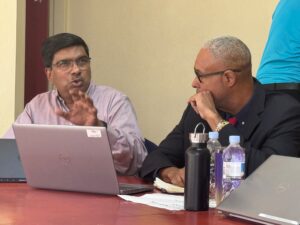
Pictured right: World Bank Task Team Leader & Senior Energy Specialist – Caribbean Energy, Ashok Sarkar, Ph.D. and Grenlec Chief Executive Officer Leroy Abraham discuss and exchange views about the CEGEB Project. “
“As Grenada increases the contribution of renewable energy to its electricity supply, investments in storage and the transmission and distribution network become increasingly important,” said Abraham. “The discussions during this mission help ensure that these investments are coordinated and support a reliable, resilient electricity system capable of accommodating more renewable energy over time.”
2. Regulatory Framework Development
Supports the development and strengthening of Grenada’s national policies and regulatory frameworks for scaling up investments in energy efficiency and renewable energy.
The component also promotes harmonization with relevant regional regulations, standards and rules, helping to establish a stronger enabling environment for future sustainable energy investments.
3. Project Implementation Support and Capacity Building
Strengthens Grenada’s capacity to plan, implement and manage energy-efficiency and renewable energy investments.
This includes technical and operational assistance for project management, procurement, financial management, monitoring and evaluation, environmental and social risk management, stakeholder engagement and strategic communications.
The component also supports capacity building for key public and private stakeholders involved in the technical, financial, environmental and social assessment and implementation of energy-efficiency and distributed renewable energy investments.
4. Financing and Scale
The total CEGEB investment for Grenada is approximately US$57.5 million.
Financing comprises approximately US$40 million from the International Development Association (IDA), US$8.5 million from the Clean Technology Fund (CTF), and US$9 million in Caribbean Development Bank (CDB) co-financing, consisting of a US$6 million loan and US$3 million grant.
Approximately US$51.6 million of the overall investment is allocated to energy-efficiency, renewable energy and related infrastructure investments, with additional resources supporting regulatory reform, technical assistance, project implementation and capacity building.
Above: Hillsborough Government School has been visited for both a walk through audit and a Mission site visit. Photography: Grenada World Bank Mission.
Expected Impact
CEGEB is expected to reduce energy consumption and operating costs in Grenada’s public buildings, expand the use of renewable energy, and strengthen the electricity grid’s ability to accommodate cleaner energy resources.

The project will also establish stronger policies, regulations and institutional capacity for future energy-efficiency and renewable energy investments. Together, these interventions are expected to reduce dependence on imported fossil fuels, improve energy resilience, lower greenhouse-gas emissions and support Grenada’s transition toward a more sustainable and climate-resilient energy system.
Follow the Grenada CEGEB Project on Facebook and Instagram
#CEGEB #Grenada #EnergyEfficiency #RenewableEnergy #ClimateResilience
Contact Info
Leslie Smith